
The KAILAS FUGA EX 3 occupies the sensible centre of KAILAS’s trail-running collection.
It is less specialised than the ultra-distance FUGA EX 330, less aggressive than the carbon-plated FUGA EX PRO, and easier to recommend to someone buying their first serious pair of trail shoes.
Its strengths are easy to understand: dependable grip, secure foot hold and a stable, protective ride.
Its main limitation is equally clear. This is not an especially soft, light or energetic shoe. The EX 3 is designed to keep the runner composed when the trail becomes unpredictable—not to make every step feel fast.
Explore the FUGA EX 3The short answer
The KAILAS FUGA EX 3 is a secure, grip-focused trail shoe for runners who value control over excitement.
- New trail runners looking for additional confidence on uneven ground.
- Heel and midfoot strikers who prefer a stable platform.
- Runners tackling wet rock, loose soil and uneven descents.
- Anyone curious about FUGA but not ready for its more specialised models.
- You have a particularly wide or high-volume foot.
- You strongly prefer soft, springy cushioning.
- You have a forefoot-dominant stride.
- Short, fast races are your main priority.
- Your trails are mostly smooth, dry and non-technical.
OTHERKIT verdict: The EX 3 is a credible alternative to familiar trail workhorses from HOKA, Salomon, Nike and Brooks. Its grip and lockdown can stand comfortably beside those better-known names, although its ride is firmer and less energetic than the category’s liveliest shoes.
What does it feel like?
Think “planted” rather than “playful”.
There is enough cushioning beneath the foot for longer outings, but the midsole does not produce the noticeably springy sensation associated with newer supercritical foams.
The shoe feels most convincing when the terrain begins to demand attention. Its structured rearfoot, broad contact platform and secure upper help reduce unwanted movement when landing on uneven ground.
On smooth trails, those same characteristics can make it feel slightly overbuilt. It runs adequately on gravel and short sections of pavement, but that is not where its personality is strongest.
The EX 3 feels like a trail shoe first.
The feature you notice first
Instead of conventional laces, the EX 3 uses KAILAS’s AWS 3.0 adjustment system.
Two independent cord sections let you adjust the forefoot separately from the upper portion of the shoe. This gives the runner more control over where pressure is applied.
In everyday language, you can hold the front of the foot more securely during descents without pulling the entire shoe painfully tight.
Once adjusted, the cords tuck into a lace pocket. This keeps them contained and reduces the chance of catching them on vegetation.
The system appears complicated at first, but its purpose makes sense as soon as the trail points downhill.
If you prefer dial-based adjustment, compare the standard EX 3 with the FUGA EX 3 BOA.
Grip is the main attraction
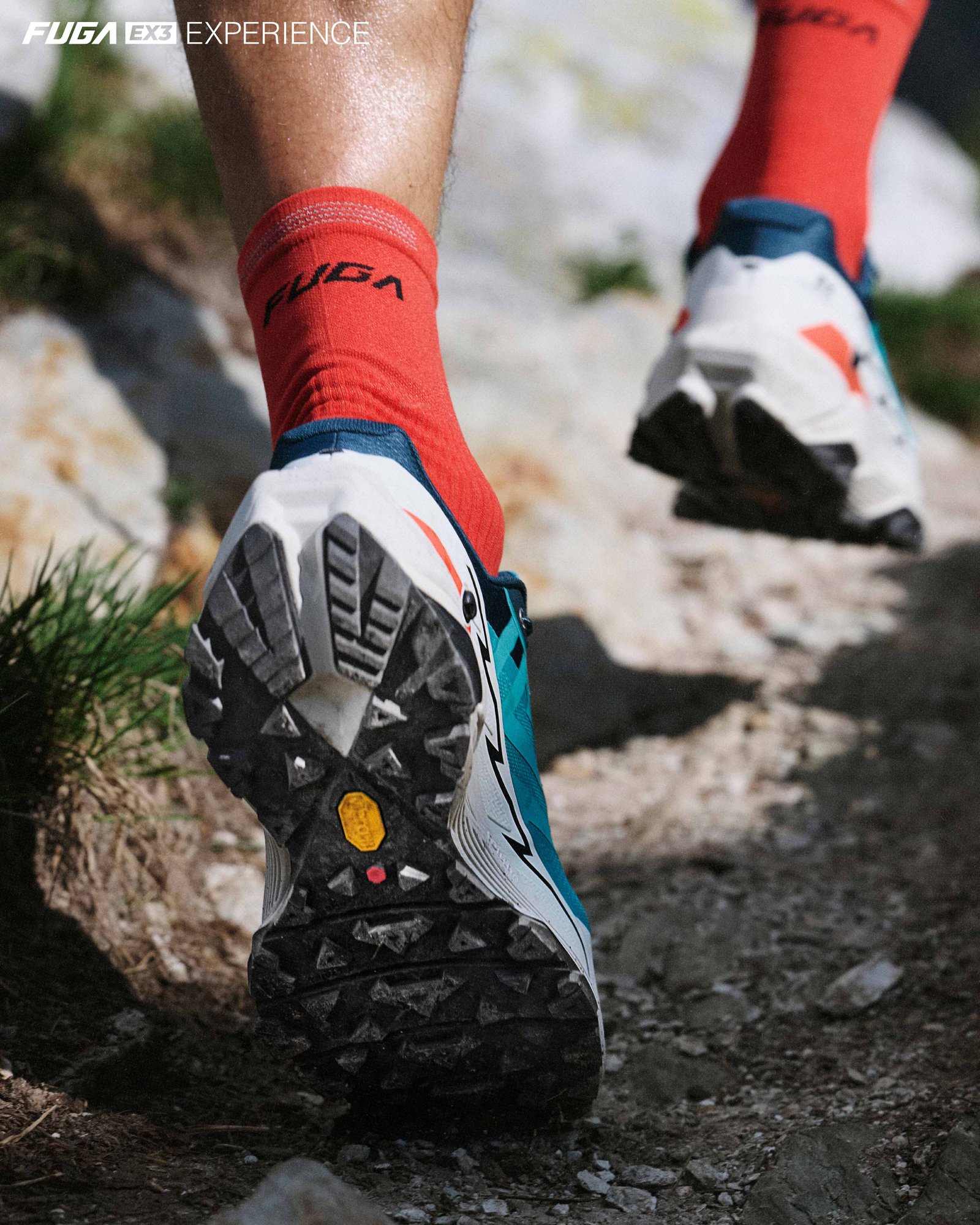
The EX 3 uses a full Vibram Megagrip outsole with multi-directional lugs.
KAILAS lists the lugs at 4 mm. That places the shoe in useful mixed-terrain territory: deep enough for loose surfaces and moderately muddy ground without being so aggressive that it becomes uncomfortable on compact trails.
- Forward-facing sections assist propulsion.
- Reversed lugs help with braking.
- Side sections support changes in direction.
- Open spaces help release loose soil and mud.
This is not a dedicated deep-mud shoe. It is designed for the sort of trail where the surface changes repeatedly—hardpack becomes rock, rock becomes forest soil, and the return route includes a short stretch of gravel or road.
That versatility is the strongest reason to consider it.
Comfort and fit
The EX 3 generally follows expected sizing in length, but width deserves more attention.
The structure narrows through the midfoot before opening slightly nearer the toes. This creates a strong feeling of hold around the centre of the foot while preserving some room at the front.
For an average or narrower foot, the result can feel reassuring.
For a broad forefoot or high-volume foot, the same construction may feel restrictive—particularly once the foot begins to swell during a long run.
Some official EX 3 versions are offered in wider fittings, although availability varies by colour and size. Check the exact men’s or women’s version rather than assuming that every colour offers the same fit.
Do not size up solely to obtain more width. Additional length does not necessarily place additional space where your foot needs it.
Check the official versions and colourwaysIs it suitable for a beginner?
Yes—with one qualification.
The EX 3 is a good beginner shoe when the runner genuinely intends to explore trails. Its stability, protection and traction can make unfamiliar ground feel less intimidating.
It may be more shoe than necessary for manicured park paths or completely dry gravel tracks. A lighter road-to-trail model could feel smoother in those conditions.
But for a newcomer expecting roots, wet stones, loose descents or changing weather, the EX 3 provides a useful margin of confidence.
- Secure two-zone adjustment.
- Dependable wet- and dry-terrain rubber.
- Stable rearfoot and broad contact platform.
- Strong protection around the toes and sides.
- Useful mixed-terrain lug pattern.
- Durable construction.
- Separate official men’s and women’s versions.
- Wide variants in selected combinations.
- The ride is not particularly springy.
- The midfoot can feel narrow.
- The heel feels more prominent than the published specification suggests.
- It is not the lightest option for short races.
- The adjustment system requires more initial attention than ordinary laces.
- The upper can admit small trail debris without a gaiter.
A mountain workhorse—not a trail super-shoe.
The FUGA EX 3 is not the obvious choice if your priorities are low weight, soft foam and a lively toe-off.
It becomes considerably more persuasive when those priorities change to grip, stability, protection and secure descending.
For many newcomers, that is the more useful place to start.
See the FUGA EX 3 in detailSECTION 2 / OPTIONAL 6-MINUTE READWant the complete construction and comparison analysis? Open technical review ↓ Close technical review ↑
Published specification
| Specification | KAILAS FUGA EX 3 |
|---|---|
| Published stack | 36 mm heel / 28 mm forefoot |
| Published drop | 8 mm |
| Published weight | 285 g in EU 42 |
| Midsole | ECCEVAI EVA-based foam |
| Outsole | Vibram Megagrip with Litebase |
| Published lug depth | 4 mm |
| Upper | Engineered nylon mesh with TPU reinforcement |
| Closure | AWS 3.0 two-zone elastic cord |
| Additional features | Lace pocket and four-point gaiter attachment |
| Intended terrain | Mixed trail |
Midsole: cushioning without much bounce
The EX 3 uses KAILAS’s ECCEVAI midsole compound.
There is a substantial amount of material beneath the heel, and the shoe provides reasonable protection from repeated impacts. The cushioning feels controlled and relatively firm rather than soft or elastic.
A shoe can feel comfortable over distance without producing a large amount of energy return. The EX 3 reduces the harshness of the ground, but it does not noticeably propel the runner into the next stride.
The positive effect is stability. Firmer foam moves less under lateral pressure, helping the shoe remain composed on uneven landings.
The negative effect is a flatter sensation at faster speeds. Runners accustomed to responsive road shoes or modern supercritical trail foams may find the EX 3 less exciting.
Its midsole is best understood as dependable rather than dynamic.
Why the drop deserves attention
KAILAS publishes an 8 mm heel-to-toe drop based on a 36 mm heel and 28 mm forefoot.
Physical measurements of a production sample have placed the heel at approximately 38.4 mm and the forefoot at approximately 24.7 mm—a difference of 13.7 mm.
Measurement methods, sample sizes and the precise calliper position can produce different results. The discrepancy should therefore not be treated as proof that either figure will describe every production shoe.
The practical conclusion is simpler: the EX 3 feels heel-biased.
Heel strikers should find this familiar and protective. Midfoot runners may still adapt comfortably. Strong forefoot strikers are more likely to notice the comparatively substantial rear of the shoe.
Outsole construction
The outsole is the most convincing part of the EX 3.
Vibram Megagrip rubber covers the sole, while Litebase construction reduces unnecessary rubber thickness. The result maintains coverage without making the shoe excessively heavy.
The lugs use multiple shapes and directions rather than one repeated pattern. This helps the outsole address propulsion, braking and side-to-side movement separately.
Published depth is 4 mm. Physical measurement of a production sample has produced approximately 3.4 mm, placing the tread near the middle of the trail-shoe category.
Upper and foot protection
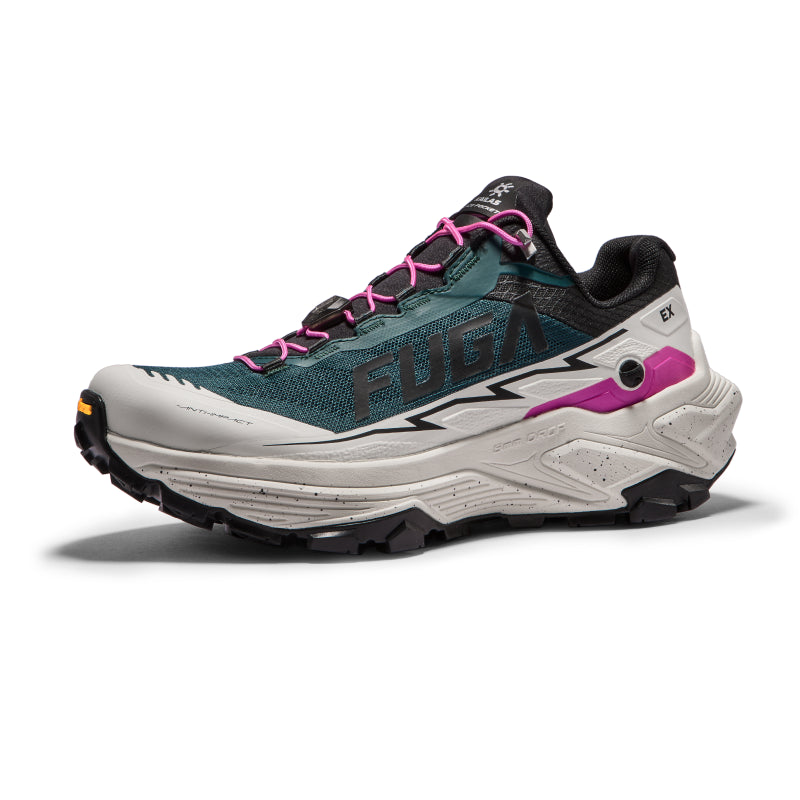
The upper combines engineered nylon mesh with strategically applied TPU film.
The mesh allows moderate airflow, while the overlays protect areas likely to encounter vegetation, loose stones and trail debris.
Protection is concentrated around the toe bumper, outside edge of the forefoot, heel structure, lace anchoring points and the midfoot where the foot is held most firmly.
The heel counter is relatively stiff. Together with the raised midsole sidewalls, it forms a bucket around the rear of the foot.
This improves security on descents but may feel restrictive to runners who prefer a soft, unstructured heel.
AWS 3.0 adjustment
The AWS system divides the shoe into two adjustment zones. The lower zone controls the forefoot, while the upper zone secures the instep and opens when removing the shoe.
This separation allows the front of the foot to remain locked without applying the same tension across the entire upper.
Its disadvantage is familiarity. Conventional laces are easier to understand and simpler to replace. The AWS cords require a short learning period and depend on specialised components.
Runners who prefer a familiar dial can consider the FUGA EX 3 BOA.
Weight
KAILAS lists the men’s EX 3 at 285 g in EU 42.
A measured men’s sample has come in closer to 293 g, while a published women’s US 7 sample weighed approximately 250 g.
These numbers place the EX 3 in the middle of the trail category rather than among its lightest shoes. Full outsole coverage, a structured heel, protective TPU and two adjustment mechanisms partly explain the weight.
Fit geometry
| Fit area | EX 3 measurement | Category reference |
|---|---|---|
| Widest internal forefoot | Approximately 92.0 mm | Approximately 95.7 mm |
| Width nearer the toes | Approximately 75.5 mm | Approximately 74.3 mm |
| External heel platform | Approximately 96.4 mm | Approximately 90.5 mm |
The shoe is narrowest through the main forefoot and midfoot hold, while providing slightly more space near the toes and a broad platform beneath the heel.
Wider feet should prioritise an official Wide version rather than attempting to compensate through additional length.
Comparison with familiar alternatives
The closest current comparisons are the HOKA Speedgoat 7, Salomon Genesis 2 and Saucony Xodus Ultra 4. Each covers mixed or technical trail use, but the priorities differ: responsiveness, agility, distance cushioning or secure control.
| Shoe | Listed men’s weight* | Listed drop | Outsole | General character | Choose it when… |
|---|---|---|---|---|---|
| KAILAS FUGA EX 3 | 285 g | 8 mm | Vibram Megagrip Litebase, 4 mm | Secure, structured and grip-focused | You value lockdown, stability and mixed-terrain traction |
| HOKA Speedgoat 7 | 275 g | 5 mm | Vibram Megagrip Traction Lug, 5 mm | Responsive and mountain-ready | You want deeper tread and a livelier cushioned ride |
| Salomon Genesis 2 | Approximately 284 g | 8 mm | All-Terrain Contagrip, 4 mm | Precise, stable and technical | You want an agile shoe for rocky and mixed terrain |
| Saucony Xodus Ultra 4 | 309 g | 6 mm | Vibram Megagrip, 4 mm | Cushioned and distance-oriented | You prioritise long-distance comfort and protection |
*Manufacturers use different reference sizes. Weight comparisons are directional rather than controlled gram-for-gram rankings.
 MOUNTAIN VERSATILITY
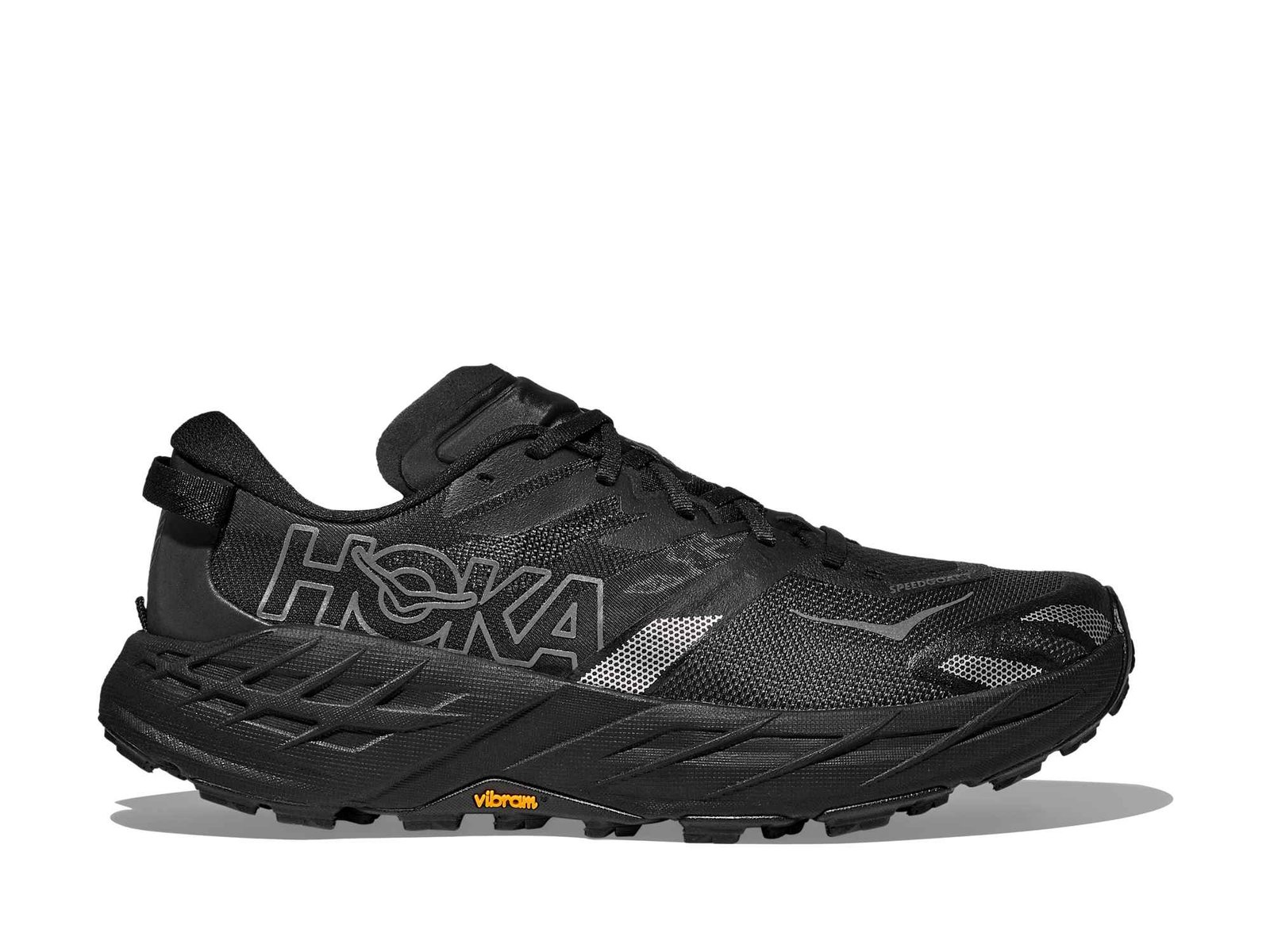
HOKA Speedgoat 7
Responsive cushioning, a 5 mm drop and deeper 5 mm Vibram lugs.
HOKA OFFICIAL PRODUCT IMAGERY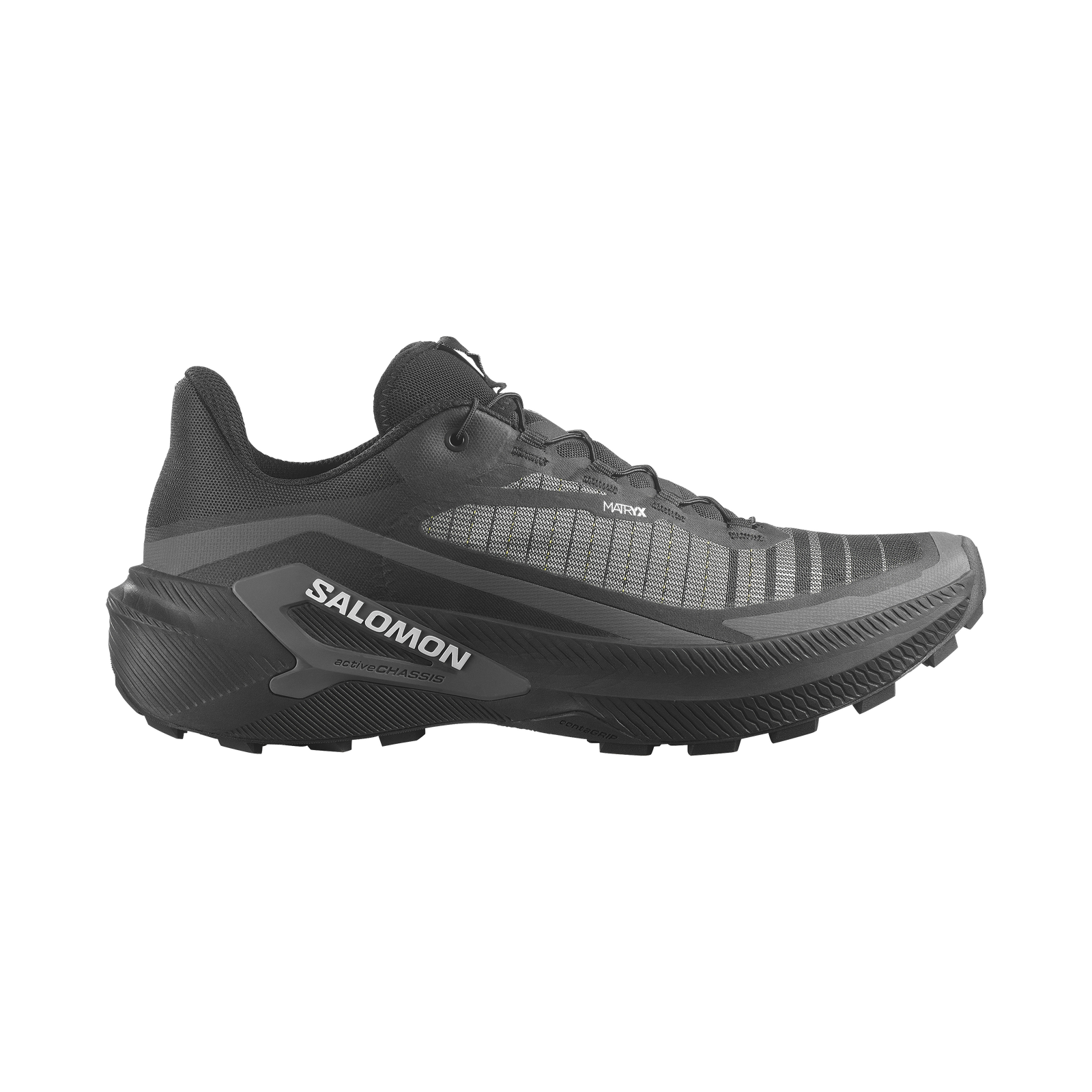 ROCKY + MIXED TERRAIN
Salomon Genesis 2
A precise, stable alternative for more technical ground.
SALOMON OFFICIAL PRODUCT IMAGERY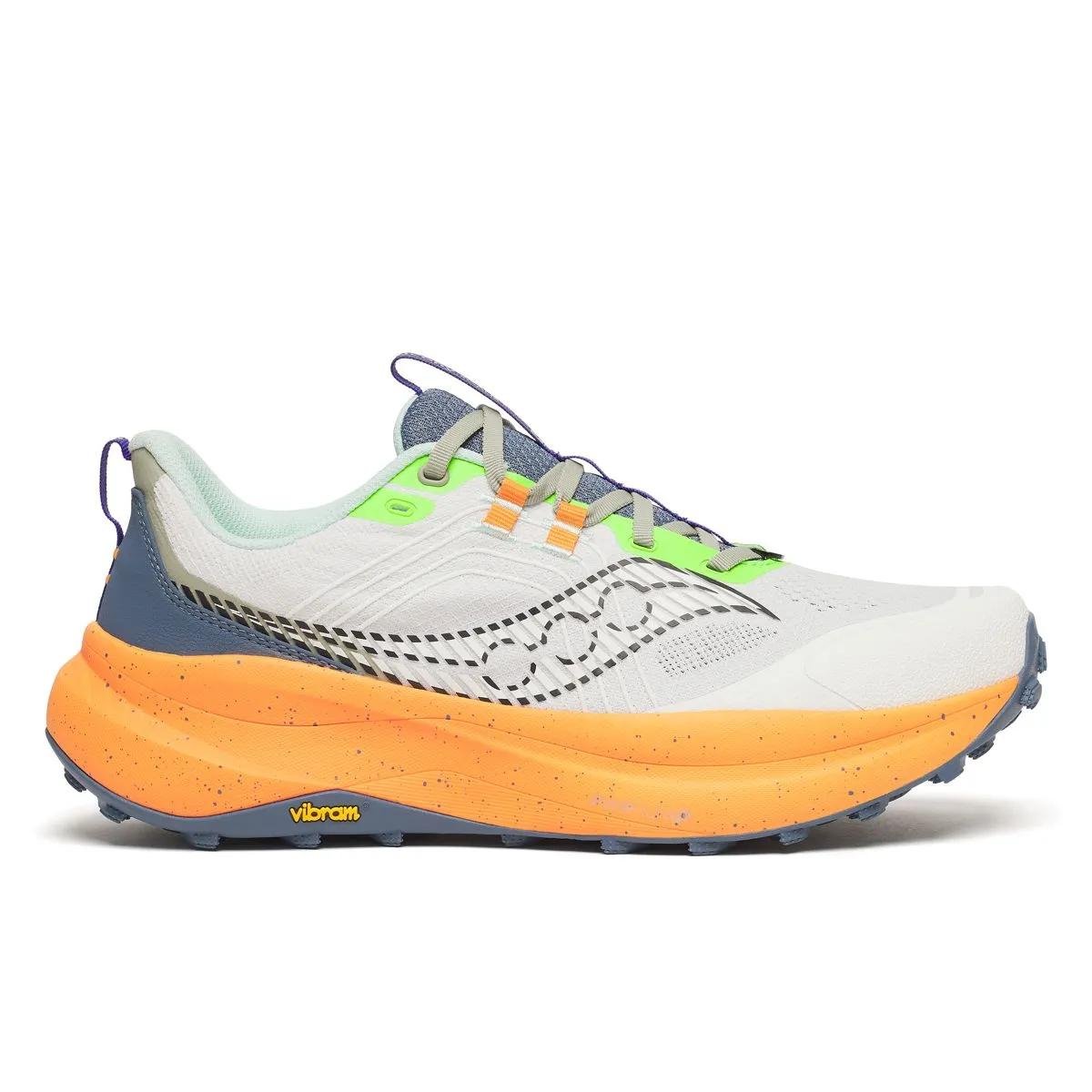 LONG-DISTANCE COMFORT
Saucony Xodus Ultra 4
High-stack cushioning and protection designed around sustained time on feet.
SAUCONY OFFICIAL PRODUCT IMAGERYEX 3 versus HOKA Speedgoat 7
The Speedgoat 7 uses a super-critical EVA midsole, a 5 mm drop and 5 mm Vibram traction lugs. It is the choice here for deeper tread and a more responsive cushioned ride.
The EX 3 uses shallower 4 mm lugs and feels more controlled. Its AWS closure separates forefoot and instep adjustment, while the structured rear holds the heel particularly firmly.
Choose the Speedgoat 7 for deeper traction and a livelier feel. Choose the EX 3 for lockdown and descending security.
EX 3 versus Salomon Genesis 2
The Genesis 2 takes a lighter-feeling, more flexible approach to technical terrain. Its Quicklace closure is familiar to many trail runners, while its chassis and Matryx upper balance agility, protection and stability.
The EX 3 feels more substantial through the heel and provides finer separation between forefoot and instep adjustment.
Choose the Genesis 2 for a more agile technical-trail experience. Choose the EX 3 for the more planted platform and two-zone hold.
EX 3 versus Saucony Xodus Ultra 4
The Xodus Ultra 4 shares the EX 3’s listed 36 mm heel stack, 4 mm lugs and full Vibram Megagrip coverage. Its PWRRUN PB cushioning sits inside a more supportive PWRRUN frame.
At a listed 309 g, the Saucony is heavier and shaped around sustained comfort. The EX 3 feels firmer and places more emphasis on holding the foot securely.
Choose the Xodus Ultra 4 for long-distance cushioning. Choose the EX 3 for a firmer, more connected and secure feel.
Together, these comparisons position the EX 3 as the secure, planted option: less springy than the Speedgoat, less agile than the Genesis and less plush than the Xodus, but particularly convincing when hold and controlled descending matter most.
Compare the KAILAS FUGA EX 3 with HOKA, Salomon and SauconyWhere it sits within the FUGA range
The EX 3 is the least specialised and the most natural starting point. It does not require the runner to be racing, covering ultra distances or specifically seeking a plated shoe.
Compare the complete FUGA collectionThe construction tells a consistent story.
- A structured heel and broad platform favour stability.
- The narrow waist and AWS closure favour lockdown.
- The full Vibram outsole favours durability and varied terrain.
- The ECCEVAI midsole favours control more than energy return.
- The substantial heel favours rearfoot strikers.
- Moderate lugs favour mixed terrain rather than extreme mud.
The FUGA EX 3 is thoughtfully constructed, but it is not universally suitable.
Runners with narrow-to-average feet, a heel-biased stride and a preference for secure trail footwear may find it exceptionally reassuring. Wider-footed runners and anyone seeking a soft, springy ride should compare it carefully before committing.
The strongest reason to buy the EX 3 is not novelty. Beneath the less familiar name and unusually technical appearance sits a credible trail workhorse—one capable of competing with established alternatives on grip, hold, stability and protection.
Explore the FUGA EX 3